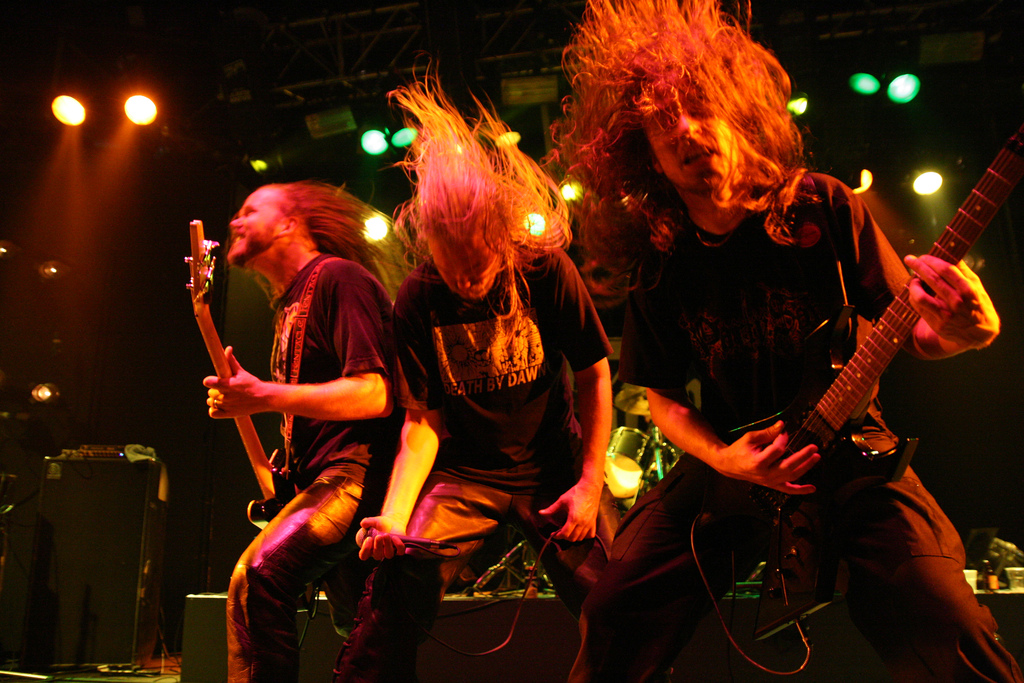
 Origin
The term "headbanger" was coined during Led Zeppelin's first US tour in 1969. During a show at the Boston Tea Party, audience members at the first row were banging their heads against the stagein rhytm with the music.
Lemmy from Motorhead, however, said in an interview on the documentary The Decline of Western Civilization II: The Metal Years, that the term "headbanger" may have originated in the band's name, as in "Motorheadbanger".
Ian Gillan, frontman of Deep Purple, when asked if he invented headbanging he said, "That's a deffinite possibility".
Health Issues
In 2005, Terry Balsamo, Evanescence guitarist, incurred a stroke from headbanging. There have also been cases of people incurring whiplash from headbanging such as Craig Jones of Slipknot and it is common to experience headaches and stiff or sore necks as a result of headbanging.
Styles
There are various styles of headbanging. Various styles are often mixed together according to taste and to the tempo and heaviness of the music. They can also be performed with eyes closed and/or in combination with hand gestures such as the sign of the horns, singing, yelling, and lip syncing. Headbangers' bodies usually bang with the head, reducing the strain on the neck and making the body move in a serpentine, up-and-down fashion to the music. There are a number of different stances a headbanger can adopt.
- The up and down: the most common style, which involves shaking the head up and down. This style is demonstrated at the climax of the "Bohemian Rhapsody" scene in the movie Wayne's World. It was also commonly used by the cartoon characters Beavis and Butt-head.
- The circular swing: swinging the head in a circular motion. This style is more commonly known as the Windmill or Helicopter. It was popularized by Ian Gillan and Roger Glover of Deep Purple, Blackie Lawless of W.A.S.P. and George "Corpsegrinder" Fisher of Cannibal Corpse, and is used by members of Slipknot, Meshuggah, Voivod bassist Jason Newsted (formerly of Metallica), the late Dimebag Darrell, Brian Fair of Shadows Fall, Corey Beaulieu of Trivium, Matt Tuck of Bullet For My Valentine, Jordan Mancino of As I Lay Dying, Joseph Bender, Jacob Clamp, and Damien Richardson of Indecent Exposure, Former Cradle of Filth guitarist James Mcilroy (who is known to do it much faster than most artists do), Cradle of Filth guitarist Charles Hedger, and Catacomb bassist Marcus Hutchens, to name a few. Some bands also put into practice synchronized windmilling (simply headbanging in unison), like Amon Amarth (four members of which windmill at once), Behemoth, Dethklok, Devildriver, and Apocalyptica members Eicca Toppinen and Perttu Kivilaakso.
- The whip: A similar headbang to the windmill. While in circular motion, the person slows down on one side, then speeds up on the other.
- Drunk style: a form of head banging in random directions, as if the person is drunk. This style is used often by Sid Wilson of Slipknot.
- The half-circle: swinging the head repeatedly from side to side in a downward arc or pendulum motion. This style is often used by Tom Arava of Slayer and of Olavi Mikkonen of Amon Amarth.
- The figure eight: shaking the head in a figure eight.
- The side to side: shaking the head from side to side, whipping the hair on each transition. This style is used by Wayne Static of Static-X, Alexi Laiho of Children of Boddom, James Root of Slipknot (during the "build-up" moments of a song), Martin Mendez of Opeth, Shavo Odadjian of System of A Down and Metallica bassist Robert Trujillo. The side to side is also known as the nono bang (shaking head in disagreement/no).
- The whiplash: an especially violent form of the traditional "up and down" style, characterized by the hair of the headbanger moving about so rapidly that it obscures their face. This style has been used by Mick Thomson of Slipknot and former former Metallica bassist Cliff Burton and Concrete Lip singer Michael Maloney.
- The Two up, Two down: Similar in style to the whiplash but instead of moving alternately up and down to the beat, the performer executes two beats 'down' and two beats 'up'. This is an attempt to accurately mimic the movements of Angus Young who appears to only 'go down' every other beat. When performed properly, the heel of the back leg is lifted on the 'down' strokes, and the heel of the front leg is lifted on the 'up' strokes.
- the bjorkman: moving the head back and forth slowly like a chicken or like a bird walking.
- The all-out: dropping on the ground, holding oneself up with the arms, and violently swinging the head between the arms. This style sometimes involves grabbing onto tables and other fixed objects, as their head movements have become so violent they seriously affect balance. Vaughan Cook and Sid Wilson from Slipknot often perform this style of headbanging during their live sets.
- The tandem. Judas Priest guitarists K.K. Downing and Glen Tipton pioneered and perfected this form of headbanging, in which they stand side by side and headbang in unison. (See also Wolf Hoffman and Jorg Fischer of Accept.Or for an example in more recent years see I Killed The Prom Queen and Parkway Drive.)
- The thrust: an antisocial form of headbanging where the person violently swings forwards and backwards from their waist, often headbutting people in front of them, or in more extreme circumstances, behind them.
- The hammer: a form of headbanging performed by Till Lindemann of Rammstein performed by semi-squatting and hitting the opposite knee of the hand you're doing the hammer motion to, while moving your head side to side or up and down. The speed of the Hammer fist goes hand in hand with the drum beat.
- The breakdown: When several members of a band (especially guitarists, if there are two) all headbang simultaneously in a violent "down and back" variant during a particularly intense part of a song. Korn were especially known for this during performances of the song Blind.
- The low-profile: a variation on the "up and down" where the performer's headbanging movements are short and more subtle, but still noticeable. This style of headbanging is used by former Opeth guitarist Peter Lindgren.
- The full body: also known as the body bang, is a variation of the "up and down" where the performer brings the head down to almost his knees, brings it back up does a standard shake down, and then goes back down to the knees, in a swinging motion, used extensively by Jens Kidman of Meshuggah, Jason Peppiatt, the vocalist of Psycroptic, Tim Lambesis, vocalist of As I lay Dying and Jonathan Davis, vocalist of Korn.
- The gallop: also known as the skip. It is a variation of the "up and down" where the performer bobs his head down, then moves the body back and lightly bobs downward, then repeats.
- The half body: Similar to the Full Body, the half body is a bizarre variation of the "up and down" where the performer keeps their head straight, but bends at the hips, usually in time with every second beat of the song. Usually the performer only bends to approximately a 45-degree angle, to maintain balance. This style of headbanging can be seen performed in tandem by James Root and Paul Gray of Slipknot, in their live performance in the movie Rollerball. It is possible this style of headbanging was formed by guitarists who found conventional headbanging too distracting while performing. This form of headbanging is used in Family Force 5's video for the song Love Addict.
The Risk of Headbanging
Anecdotal reports of head banging induced injury include hearing loss, stroke, and mild traumatic brain injury, but there has been little formal research into head banging.
Declan Patton and Professor Andrew McIntosh from the
The researchers attended hard rock and heavy metal concerts including Motörhead, Ozzy Osbourne and Skid Row, and identified that the up-down style was the most common head banging technique. They constructed a theoretical head banging model of this popular style to examine the effect the range of head and neck motion has on injury severity. A focus group of ten musicians was used to calculate the average tempo of their favourite head banging songs.
The authors found that there is an increasing risk of neck injury beginning at tempos of 130 beats per minute related to the range of motion in the head banging style.
The average head banging song has a tempo of about 146 beats per minute. The authors suggest that at this tempo head banging may cause headaches and dizziness if the range of movement of the head and neck is more than 75º. They report that at higher tempos and greater ranges of motion there is an additional risk of neck injury.
So could someone render themselves unconscious while head banging? Unlikely, say the authors, unless they are banging their head on the stage or connect with someone else's head.
And what of two of the most famous head bangers, Beavis and Butt-head? When head banging at a tempo of 164 beats per minute to "I Wanna be Sedated" the range of motion of Beavis' head and neck is about 45º, say the authors, so he would be unlikely to sustain any injury. But the news for Butt-head may not be so rosy. Preferring to head bang at a range of motion of 75º, he may well experience symptoms of headaches and dizziness.
Luckily, there are a number of possible ways to protect against these injuries, write the authors. These include calling for bands such as AC/DC to play songs such as "Moon River" instead of "Highway to Hell", public awareness campaigns headed by musicians such as Cliff Richard and the labelling of music packaging with anti-head banging warnings.
No comments:
Post a Comment